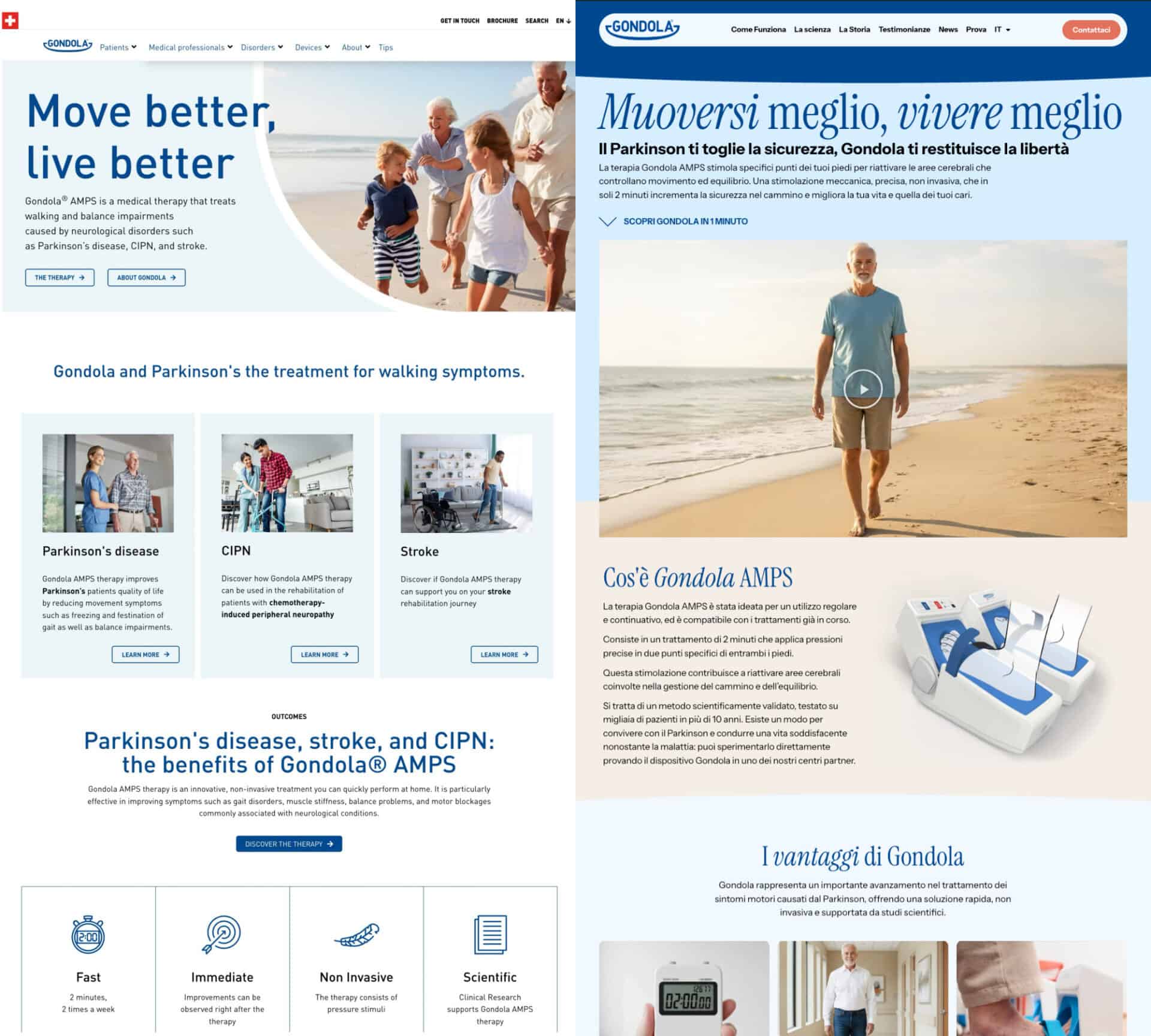
Gondola sito prima e dopo
The Gondola website, before and after the restyling (on the right). The primary language has shifted from English to Italian (the core market). Key additions include a video that summarizes essential information in just over a minute and previously missing device imagery. Site navigation has been streamlined by merging sections that were previously isolated and difficult to browse. Fonts and colors are now "warmer," and the copy adopts an empathetic tone. Overall, the brand image is less clinical and much closer to the patient.

Gondola is a medical device designed to improve the quality of life for patients with Parkinson’s disease and neuropathies through mechanical peripheral stimulation of the feet. It is an innovative, painless, and fast therapy (lasting only 96 seconds) with no side effects.

Since mid-November 2025, when the new Gondola Medical website went live, something shifted. Not gradually, but intentionally. The launch of the new identity coincided with a transformation touching every channel, every language, and every narrative surrounding AMPS therapy. The data from the last month reflects a company that is finally speaking its patients’ language.

Growth Rooted in Truth

From mid-November to today, visitors and inquiries have grown significantly—an increase of +145% compared to the previous 90 days. This wasn’t a linear or predictable rise; it was the growth of something that works because it is authentic. The new website opened the doors, and people walked in. They searched, they read, they watched the videos. Most importantly, they contacted Gondola to receive real information from real doctors.

This surge is no coincidence. It is the direct result of every creative decision, every word chosen, and every communication strategy introduced by Ex Machina’s creative division in coordination with the Gondola team.

Videos That Tell Real Stories

The most immediate change was the systematic introduction of video content. Not anonymous corporate videos, but videos where Stefano Tassin, the creator of Gondola, speaks directly to the camera. He discusses the research, explains the origins of AMPS therapy, and demonstrates how mechanical stimulation reaches the nerves in the feet. He is someone who knows his subject deeply, lives this technology every day, and has chosen to share it all without filters.

Alongside these is something even more powerful: patient video testimonials. They aren’t sanitized or perfect; they are real. They are “before and after” stories told by people who have experienced the therapy. A steadier step, a less tiring walk, a regained confidence in one’s body. These aren’t just medical promises; they are lives being changed.

A Global Voice, Faithful to Every Language

The extraordinary detail? These videos are no longer trapped in Italian. Thanks to AI-driven dubbing, Stefano’s videos and patient testimonials are now available in English, German, and French. These aren’t just subtitles—it is Stefano’s voice speaking directly to German, French, and English audiences. It is the patient’s own testimony sharing what it means to regain movement, in the listener’s native tongue.

This isn’t just a technical detail; it’s a deeply human choice. It means a patient in Germany doesn’t have to read a translation—they hear a voice that looks them in the eye and speaks to them directly. It creates presence and proximity.

YouTube Channel Reorganization

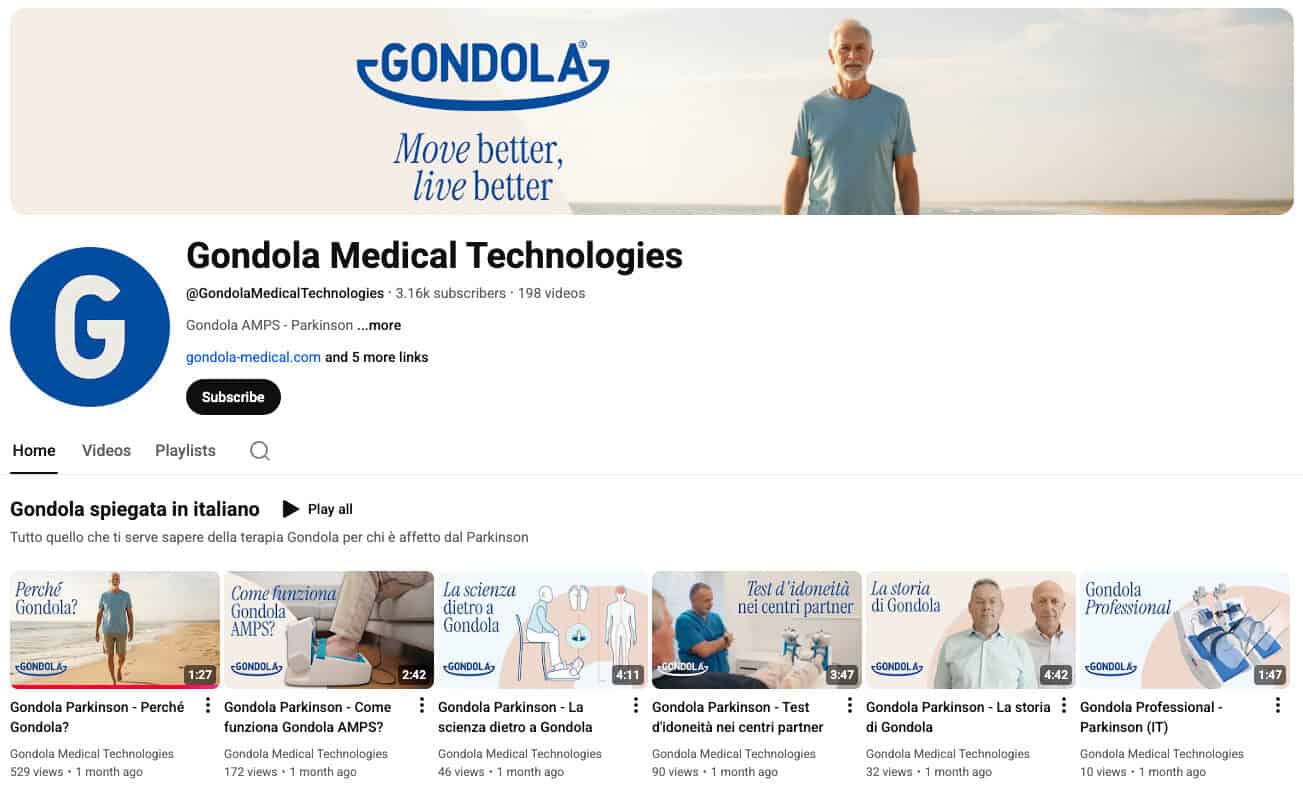
The Gondola YouTube channel has been completely restructured. No longer a cluttered repository, it is now organized by language and category. A visitor from London finds videos in English, logically arranged. Someone from Paris experiences the same quality of storytelling in French. A user from Berlin finds order and clarity in German.

Every video is part of a consistent visual identity. It’s not a collection of random clips, but a library of knowledge where the Gondola brand is recognizable in every frame and transition. The experience is unified, even as the language changes. Gondola has finally become global without losing its local touch.

Targeted Campaigns: When Empathy Becomes Strategy

On social media and Google, campaigns no longer fire generic messages into the void. They are designed with the new communicative sensitivity introduced by EXM/Creative. A person experiencing the first symptoms of Parkinson’s doesn’t see an ad that “medicalizes” or frightens them. Instead, they see a video of a woman sharing how she started dancing with her husband again. A man who has lost confidence in his stride doesn’t see a scientific chart; he sees Stefano explaining, with simplicity, how mechanical stimulation helps nerves communicate better with the brain.

Every campaign is built around conscious emotion: reasoned hope, supported by real science. Not blind hope, but informed hope. These campaigns reach the right people at the right time with the right message. They work because they don’t promise miracles—they offer understanding and a real possibility.

Making Scientific Studies Accessible

There is an element that often remains invisible but is fundamental to Gondola’s credibility: scientific research. Over the years, clinical studies on AMPS therapy have accumulated—robust research published in international journals and conducted by renowned institutions. However, they were often hard to find, difficult for patients to read, and sometimes inaccessible even for doctors.

Until now.

We have introduced a chatbot trained exclusively on Gondola’s scientific studies. Anyone visiting the site, YouTube channel, or social media can now ask a question. The chatbot responds not with opinions, but with real research. What does the research say about the safety of AMPS therapy? How long before results are seen? How does it work for patients with different characteristics?

The chatbot is multilingual. An Italian patient and a German patient receive the same scientific answers in their own language. This is democratized research. For doctors, it’s a valuable resource; for patients, it’s the confirmation that solid science sits behind Gondola, not empty promises.

Real Impact: Where Communication and Credibility Converge

What has been happening since November is more than just a brand rebirth. It is the intersection of two forces: empathetic communication and accessible science. The Gondola device hasn’t changed medically; AMPS therapy works today just as it did yesterday. What has changed is Gondola’s ability to say, “It works, and I will show you why.”

A patient arrives through a testimonial video of a woman walking better. They are convinced by truth, not advertising. To verify safety, they consult the scientific chatbot. They read the research behind the therapy. They feel welcomed by social campaigns that speak to them directly. They contact Gondola not because they were sold a promise, but because they saw, read, and understood.

And they are contacting Gondola in record numbers.

The logo underwent a subtle yet impactful restyling: the proportions were balanced for a better width-to-height ratio, the bottom curve was refined, and the tagline font was updated. Additionally, the Swiss flag was removed to achieve a cleaner, more modern aesthetic.

The Architecture of Trust

What EXM/Creative has built with Gondola is more than a restyling; it is an architecture of trust where every element supports the others. Stefano’s videos build authority. Testimonials foster identification. The scientific chatbot provides security. Targeted campaigns create awareness. The organized YouTube channel ensures accessibility.

It isn’t a random collection of features. It is a coherent system where tone, aesthetics, science, and empathy work in harmony.

Gondola Now Speaks to Everyone

What began in mid-November is a global conversation, built locally, supported by research, told through real videos, amplified by smart campaigns, and rooted in accessible science.

Gondola hasn’t become “more medical”—it has become more human. And that is exactly why more and more people in Italy, Germany, France, and beyond are choosing to listen, to engage, and to trust.

gondola-medical.com